
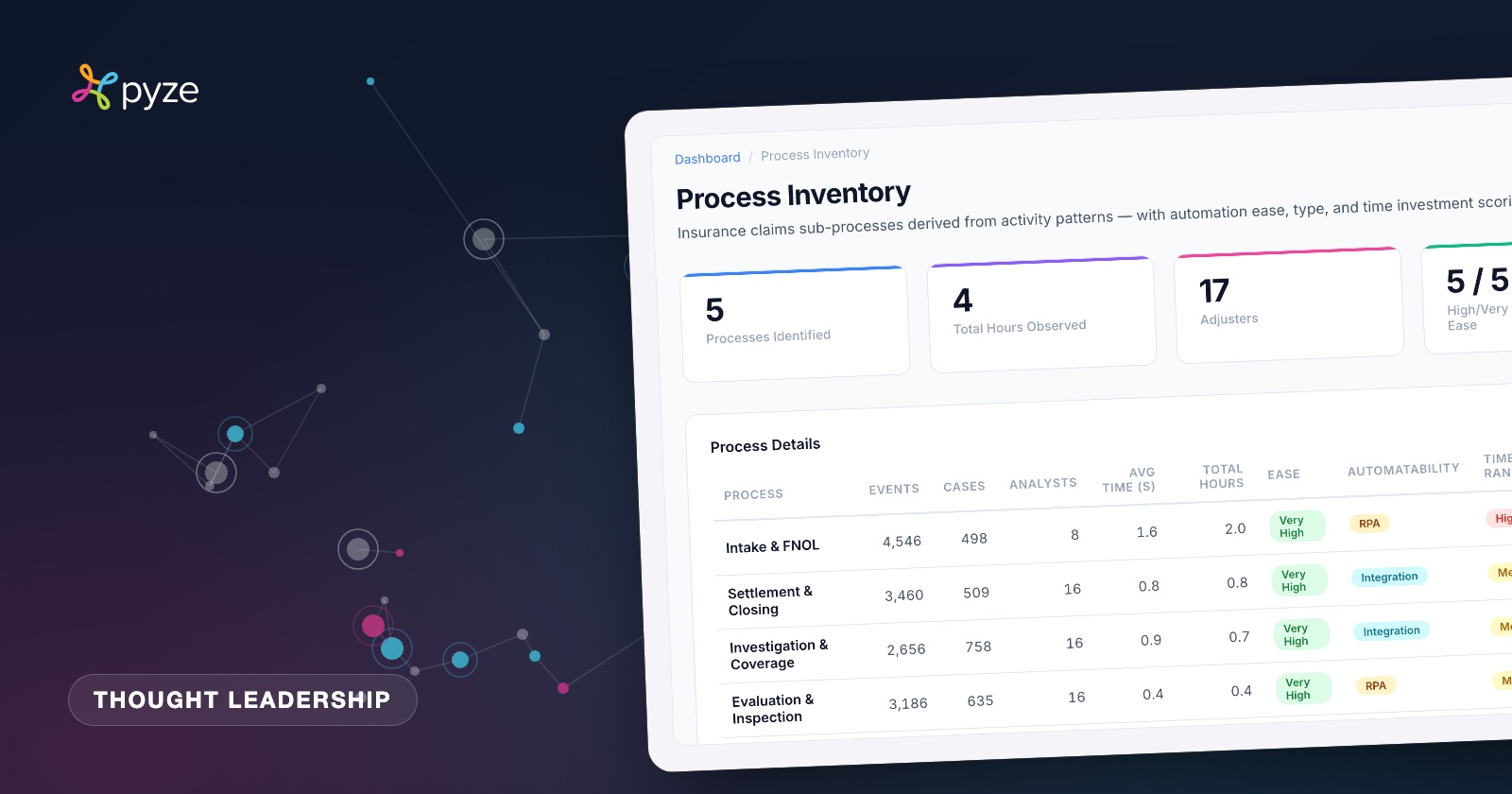
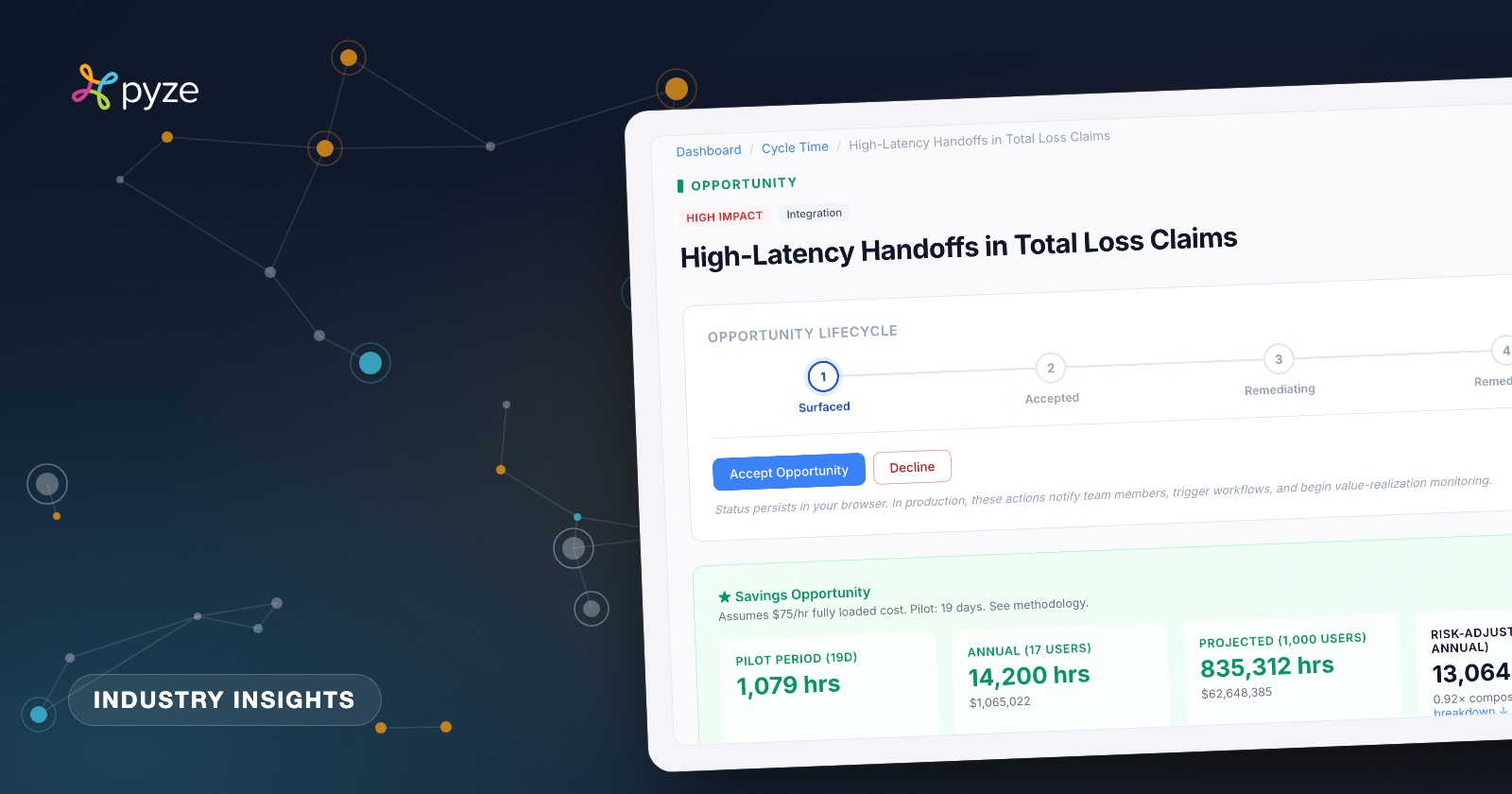
Measuring administrative work in transportation and logistics
Pyze measures how scheduling, exception handling, documentation and customer coordination are performed, and prices the work that can be removed.
Engagement archetypes from Pyze deployments in logistics and order operations rather than a single named account.
Logistics operations apply sophisticated optimisation to the physical network, with little measurement of the administrative work that supports it. Appointments, documentation, exceptions and the related correspondence consume a large share of the operating day.
Common Findings in Transportation & Logistics
Four patterns that recur across engagements, each shown with the measurement and the resulting change.
Appointment scheduling is performed by a bot, with manual fallback when the bot fails.
AgentifyBot reliability is materially lower than assumed, and the manual fallback is not measured because it happens in a portal and an inbox.
Slots are obtained, moved and confirmed against the constraints, with escalation only when no acceptable option exists.
Documentation errors surface at the dock and can cost an entire load.
AutomateThe errors trace to a small number of upstream steps where a value is transcribed instead of integrated.
The transcription is removed at source, which eliminates the error instead of detecting it later.
Customers request status updates, and each update is prepared manually.
AgentifyThe answer already exists in the transport system and is assembled by a person for each request.
Status is assembled and issued from the record, with exceptions routed already diagnosed.
Exception handling consumes the planning team’s time.
SimplifyExceptions are concentrated in recurring causes, most with a documented resolution path.
Recurring causes are handled without a person, and remaining exceptions reach a planner with the cause attached.
Opportunity Register
A sample register, sorted by the lever that resolves each opportunity. In an engagement, each line carries measured hours, a named owner and the evidence it was derived from.
Systems typically instrumented
Capture covers browser-delivered and thick-client applications, including virtualized estates, with no change to how anyone works.
Roles Involved
Instrumentation is configured per application rather than per person, so the population in scope is set during scoping and is not a deployment constraint.
How an Engagement Runs
Baseline, blueprint, transform, prove
The same four stages apply in every sector. The fourth stage repeats the baseline measurement, which makes the engagement an ongoing operating capability rather than a one-time report.
Baseline
What the work costs today, measured across every person and application.
Blueprint
Procedures, application rules and execution evidence, read as one target state.
Transform
Where each of the five levers applies, priced and owned.
Prove
The after state measured against the baseline, using the same method.
Frequently Asked Questions
Much of our work happens in carrier portals we do not own. Can you measure that?
Functions
Related
Start with a measured baseline
Six weeks from instrumentation to a priced opportunity register, and the baseline stays in place so later quarters are measured rather than re-estimated.