
Identify capacity in financial crime operations before investing in technology
Pyze measures how KYC, transaction monitoring and payments investigations are performed, identifies where AI agents apply, and measures the result after deployment.
Measured in a single European bank engagement across financial crime operations. Identified value; realized value is tracked separately against the same baseline.
Financial crime teams are measured on alerts cleared and cases closed, which does not show how the work is performed. The variation between two analysts on the same case type is often wider than the variation between a strong quarter and a weak one, and it is not visible in the case management system.
Common Findings in Banking & Financial Services
Four patterns that recur across engagements, each shown with the measurement and the resulting change.
Every case receives the same quality check regardless of risk.
SimplifyReturn rates from second-line review are flat across segments and do not rise with customer complexity. Uniform checking does not improve risk coverage.
Full second review is reserved for the segments and triggers that produce returns, and the remainder is sampled. The control becomes stronger and less costly.
Screening produces more matches than analysts can review, and most are discounted.
AgentifyThe discounting follows a documented disposition rule, which makes it a candidate for an AI agent.
An agent performs first-pass triage against the written rule and presents only the matches that need judgement. Each agent decision is recorded on the case with its rationale, so the control remains auditable.
Two analysts close the same case type, and one takes a third longer than the other.
StandardizeThe difference is the order of lookups and knowing which register answers the ownership question. Both can be taught quickly and neither requires a system change.
The top quartile technique becomes the documented standard, and conformance is scored continuously instead of sampled in an annual review.
The measured workload at one end of the team is three times that at the other.
RebalancePart of the difference is explained by role. The remainder is imbalance, verified case by case against each analyst’s measured day.
Work is rebalanced within a role and segment, capped at what the busiest analyst already carries. Capacity is released with no technology spend.
Opportunity Register
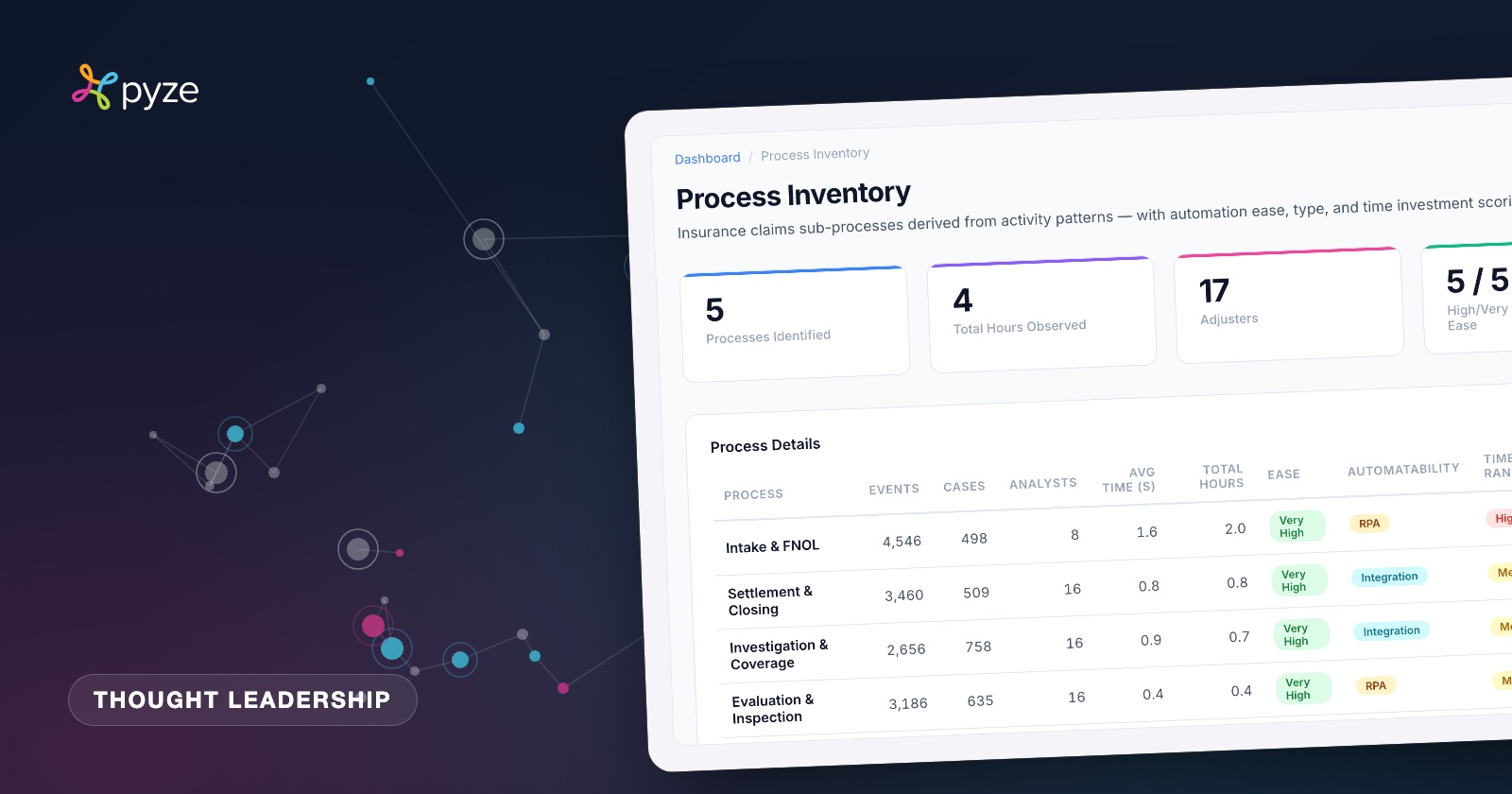
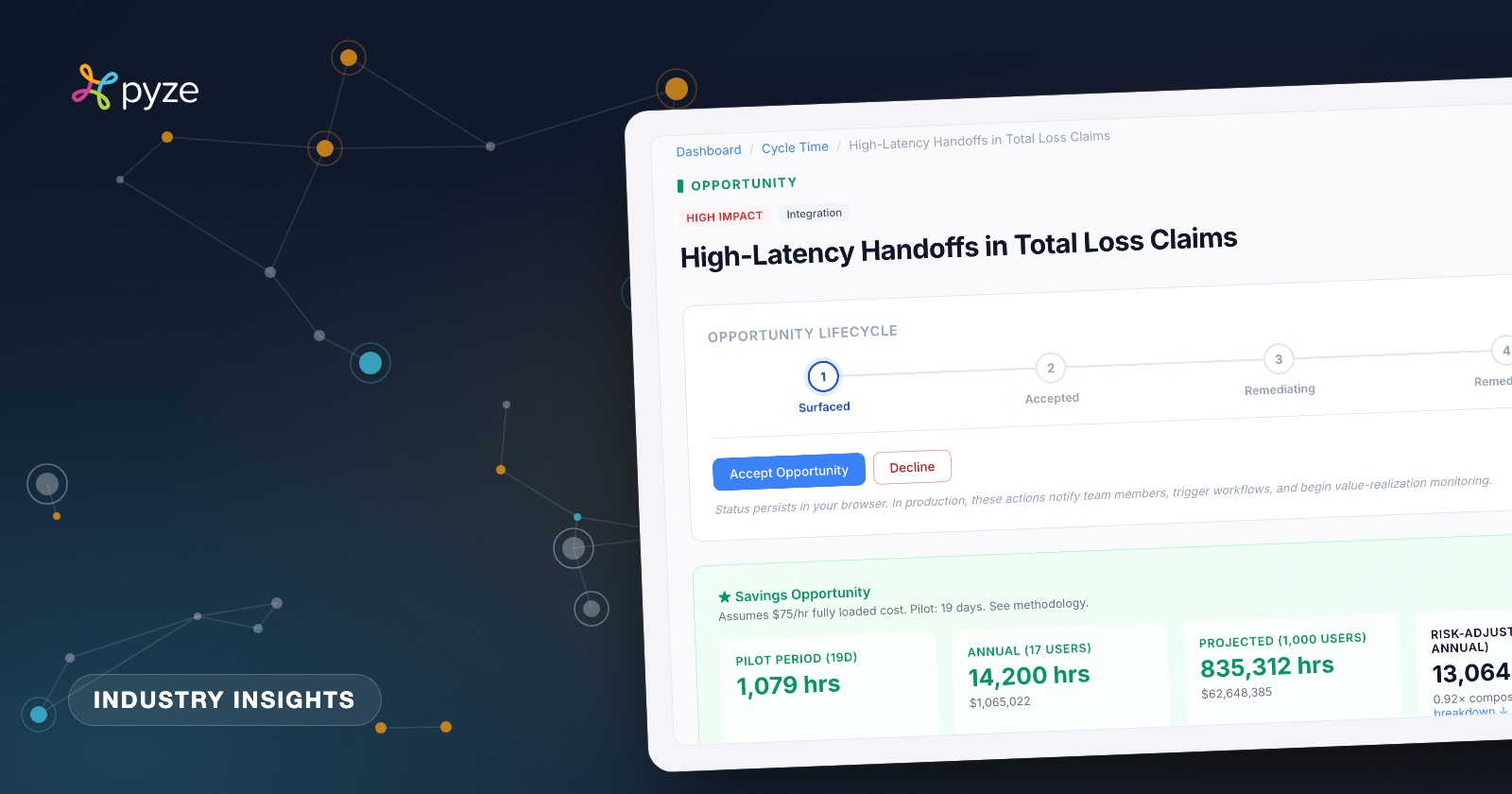
A sample register, sorted by the lever that resolves each opportunity. In an engagement, each line carries measured hours, a named owner and the evidence it was derived from.
Systems typically instrumented
Capture covers browser-delivered and thick-client applications, including virtualized estates, with no change to how anyone works.
Roles Involved
Instrumentation is configured per application rather than per person, so the population in scope is set during scoping and is not a deployment constraint.
How an Engagement Runs
Baseline, blueprint, transform, prove
The same four stages apply in every sector. The fourth stage repeats the baseline measurement, which makes the engagement an ongoing operating capability rather than a one-time report.
Baseline
What the work costs today, measured across every person and application.
Blueprint
Procedures, application rules and execution evidence, read as one target state.
Transform
Where each of the five levers applies, priced and owned.
Prove
The after state measured against the baseline, using the same method.
Financial and economic crime optimisation
8,000 analysts across KYC, transaction monitoring and payments. 250,000 annual hours and more than €5M in savings identified, with the conformance baseline left in place to measure what the remediation recovered.
Read the walkthroughFrequently Asked Questions
Does this require access to customer data?
Task mining is not permitted under our corporate standards. Does that rule Pyze out?
How is the benchmark set?
Functions
Related
Start with a measured baseline
Six weeks from instrumentation to a priced opportunity register, and the baseline stays in place so later quarters are measured rather than re-estimated.