
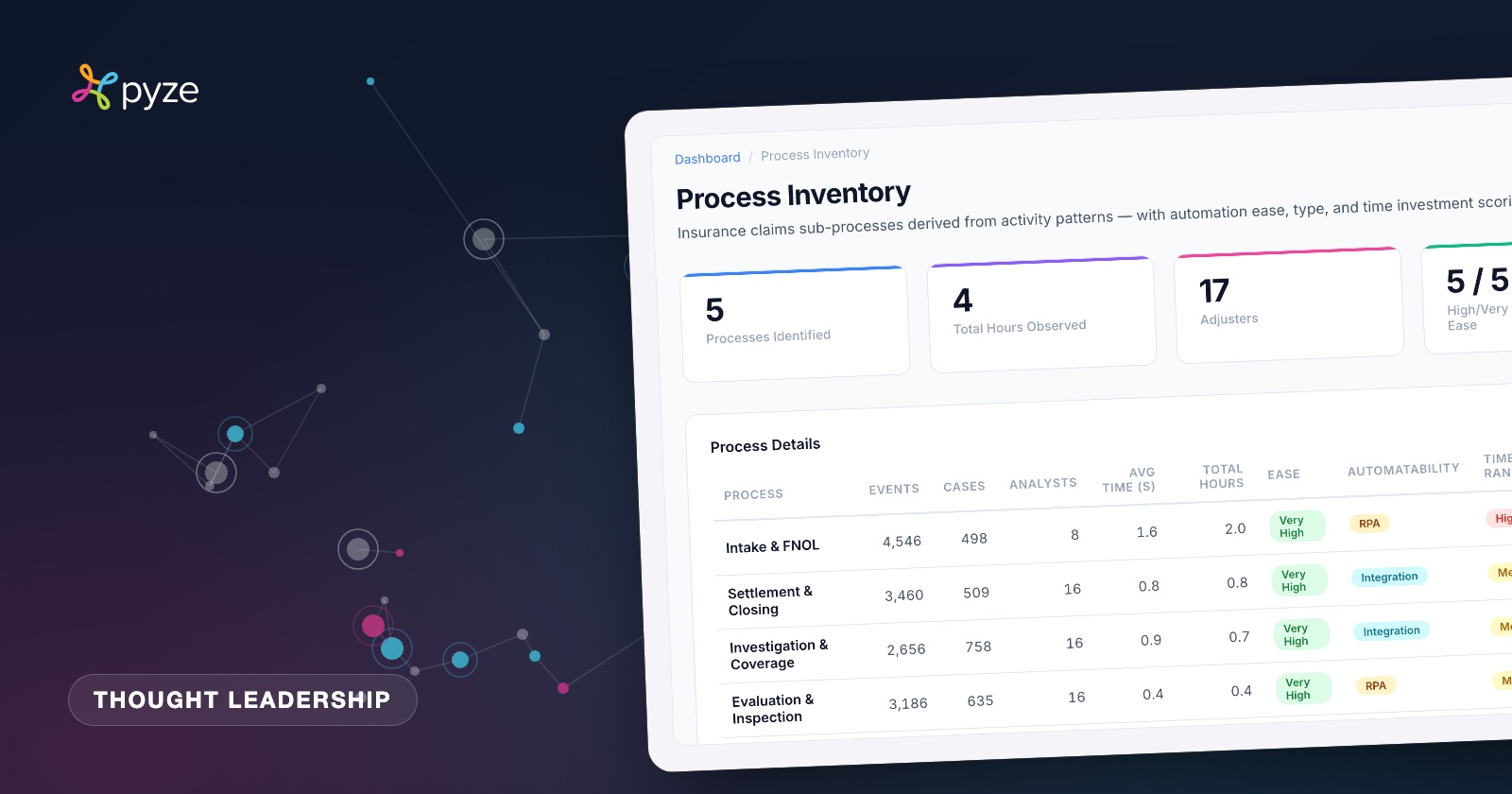
Measuring the operation behind the customer experience
Pyze measures how order, returns, fulfilment and customer service work is performed behind the storefront, and prices the work AI agents can remove.
Engagement archetypes from Pyze deployments in retail and adjacent order operations rather than a single named account.
Retailers have spent a decade automating the customer-facing journey. The operation behind it, where an exception becomes manual work in a spreadsheet, has received far less attention and accounts for much of the cost per order.
Common Findings in Retail & E-commerce
Four patterns that recur across engagements, each shown with the measurement and the resulting change.
Storefront conversion is strong, but cost to serve has not decreased.
SimplifyCost to serve is concentrated in the exception path, which is worked outside the systems that report on it.
The exception path is measured and decomposed, making its cost visible.
Returns handling between the warehouse and the refund is not measured.
StandardizeDecisioning is consistent in policy but inconsistent in practice, with a wide spread between agents on identical returns.
The documented standard is updated to reflect the practice of the best agents, and conformance is scored continuously.
Peak season brings temporary staff and a drop in productivity.
StandardizeThe learning curve flattens earlier than the training programme assumes, and tenure does not identify which staff would benefit most from coaching.
Training is focused where the learning curve is still rising, which shortens time to competence without lengthening the programme.
Customer contacts about order status consume the team’s time.
AgentifyMost of the answer already exists in the order record and is retrieved by a person.
Status questions are answered from the record, with exceptions escalated already diagnosed.
Opportunity Register
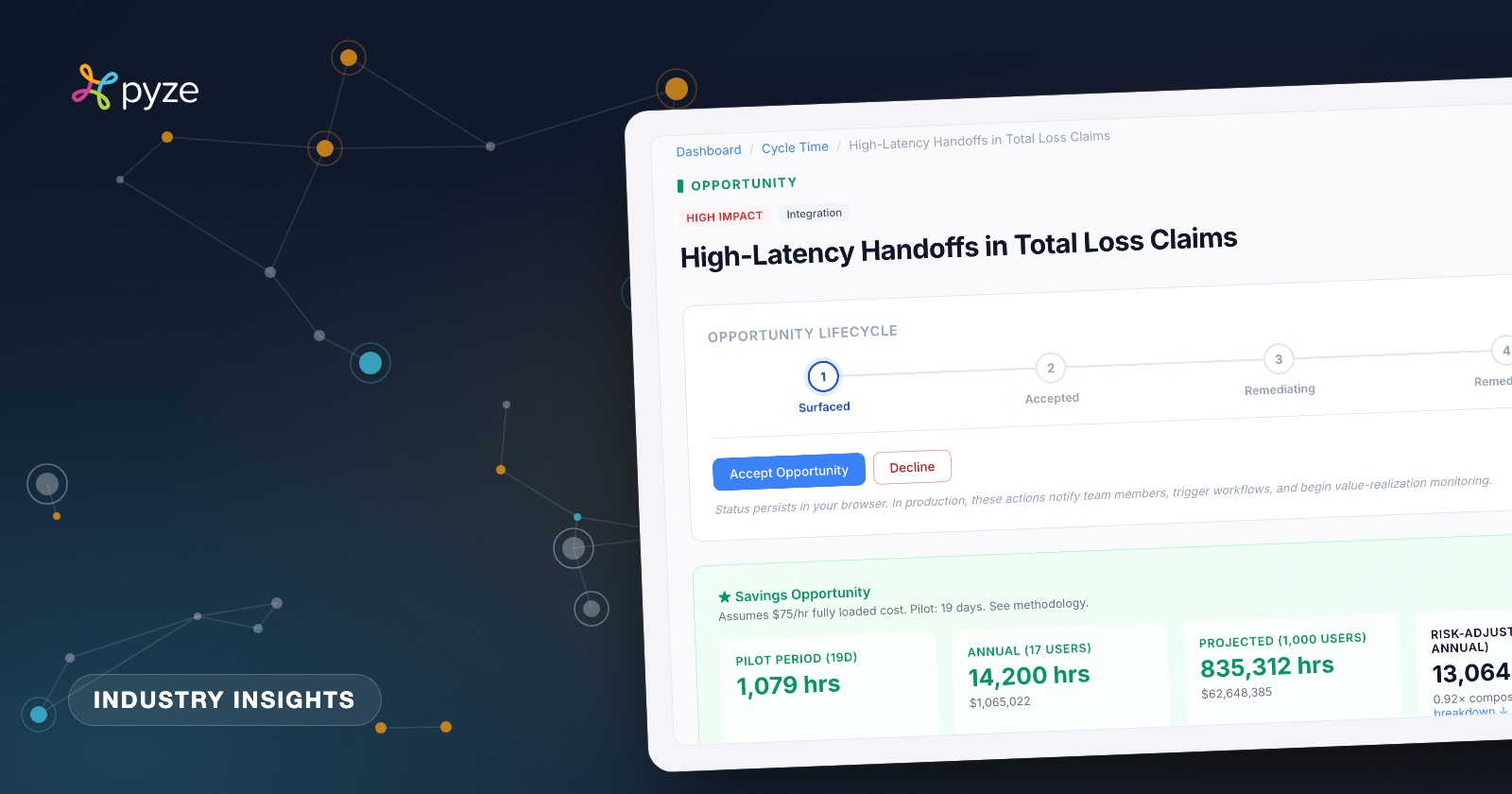
A sample register, sorted by the lever that resolves each opportunity. In an engagement, each line carries measured hours, a named owner and the evidence it was derived from.
Systems typically instrumented
Capture covers browser-delivered and thick-client applications, including virtualized estates, with no change to how anyone works.
Roles Involved
Instrumentation is configured per application rather than per person, so the population in scope is set during scoping and is not a deployment constraint.
How an Engagement Runs
Baseline, blueprint, transform, prove
The same four stages apply in every sector. The fourth stage repeats the baseline measurement, which makes the engagement an ongoing operating capability rather than a one-time report.
Baseline
What the work costs today, measured across every person and application.
Blueprint
Procedures, application rules and execution evidence, read as one target state.
Transform
Where each of the five levers applies, priced and owned.
Prove
The after state measured against the baseline, using the same method.
Frequently Asked Questions
Our volumes are highly seasonal. Does that distort a baseline?
Functions
Related
Start with a measured baseline
Six weeks from instrumentation to a priced opportunity register, and the baseline stays in place so later quarters are measured rather than re-estimated.