
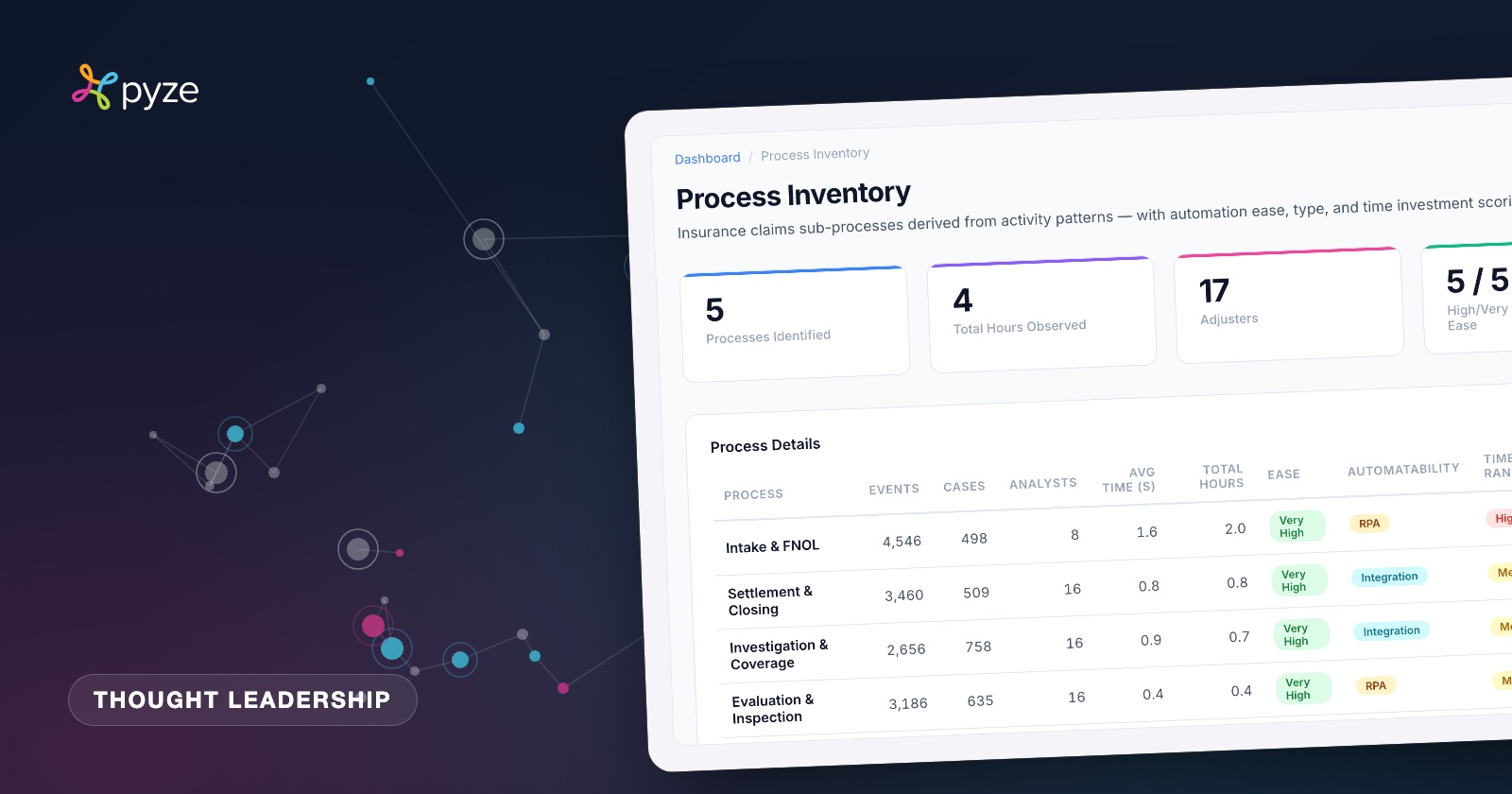
Measure How Claims Are Handled and Identify Where to Reduce Cycle Time
Pyze measures how adjusters and claims staff work each claim from first notice of loss to closing, identifies where handling time and rework accumulate, and measures the result after changes are made.
Engagement archetypes from Pyze deployments across claims and case handling operations rather than a single named account.
The claims system records status changes, reserves and payments. It does not record the work between them: the coverage checks, the estimate reviews, the searches through email and attachments, and the re-keying between the claims platform, the estimating tools and the document repository. Those activities determine cycle time and cost per claim, and they are measured only by sampling.
Common Findings in Claims Management
Four patterns that recur across engagements, each shown with the measurement and the resulting change.
First notice of loss intake takes several contacts to complete, and the claim is often missing information when it reaches an adjuster.
AgentifyIntake staff re-enter details from emails, portal submissions and call notes into the claims platform. The fields that are most often incomplete are the same ones on each claim type, and adjusters spend the first touch requesting them.
Intake details are extracted from the submitted material and checked against required fields before assignment, so the first adjuster touch starts from a complete file.
Coverage verification and investigation take different amounts of time for claims of the same type and severity.
StandardizeHandlers consult the policy record, endorsements and prior claims in separate systems, and the order and number of checks varies by person. The longest paths include repeated policy lookups for the same claim.
The checking sequence of the fastest handlers on comparable claims is documented as the standard path, and repeated lookups are removed from it.
Estimating and evaluation are a bottleneck for property and auto claims, and supplements generate repeated review.
SimplifyTime is spent moving estimate data between the estimating tool, the claims platform and email, and reconciling supplements against the original scope. Reviewers open the same documents more than once per claim.
The hand-offs between the estimating tool and the claims platform with the highest switching cost are consolidated, and supplement review is routed by the measured causes of rework.
Adjuster workloads are uneven, and some inventories age while others are cleared quickly.
RebalanceAssignment is based on claim counts, but the measured effort per claim varies by type, complexity and the number of external parties involved. Effort per adjuster differs more than claim counts suggest.
Assignment and queue rules are adjusted to measured effort by claim type, which levels inventories across adjusters and teams.
Opportunity Register
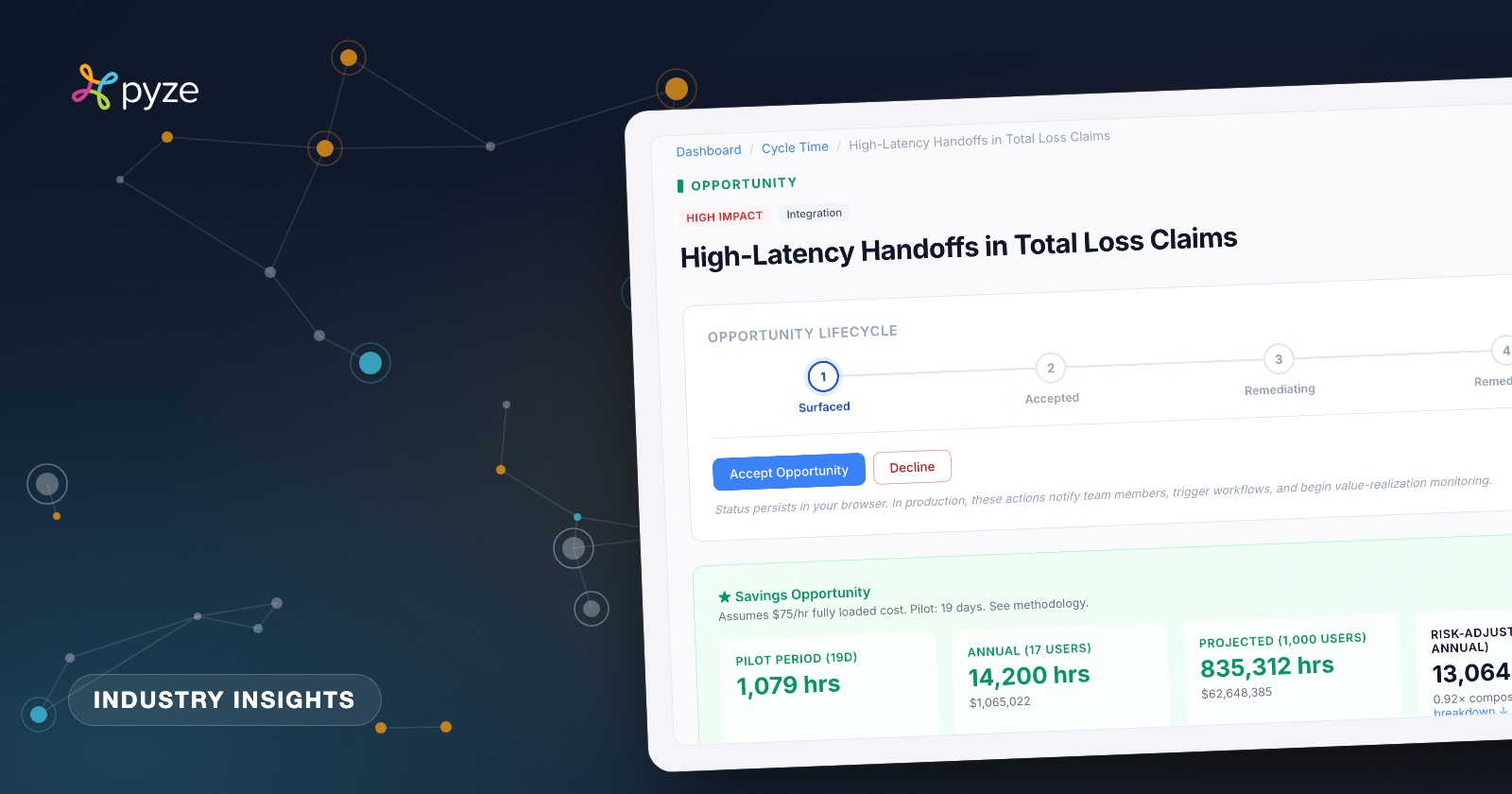
A sample register, sorted by the lever that resolves each opportunity. In an engagement, each line carries measured hours, a named owner and the evidence it was derived from.
Systems typically instrumented
Capture covers browser-delivered and thick-client applications, including virtualized estates, with no change to how anyone works.
Roles Involved
Instrumentation is configured per application rather than per person, so the population in scope is set during scoping and is not a deployment constraint.
How an Engagement Runs
Baseline, blueprint, transform, prove
The same four stages apply in every sector. The fourth stage repeats the baseline measurement, which makes the engagement an ongoing operating capability rather than a one-time report.
Baseline
What the work costs today, measured across every person and application.
Blueprint
Procedures, application rules and execution evidence, read as one target state.
Transform
Where each of the five levers applies, priced and owned.
Prove
The after state measured against the baseline, using the same method.
Frequently Asked Questions
We already have analytics on the claims platform. What does this add?
Does this capture claim content or personal information?
Can this be applied to both insurance and healthcare payer claims?
Associated Titles
Industries
Other functions
Related
Start with a measured baseline
Six weeks from instrumentation to a priced opportunity register, and the baseline stays in place so later quarters are measured rather than re-estimated.