
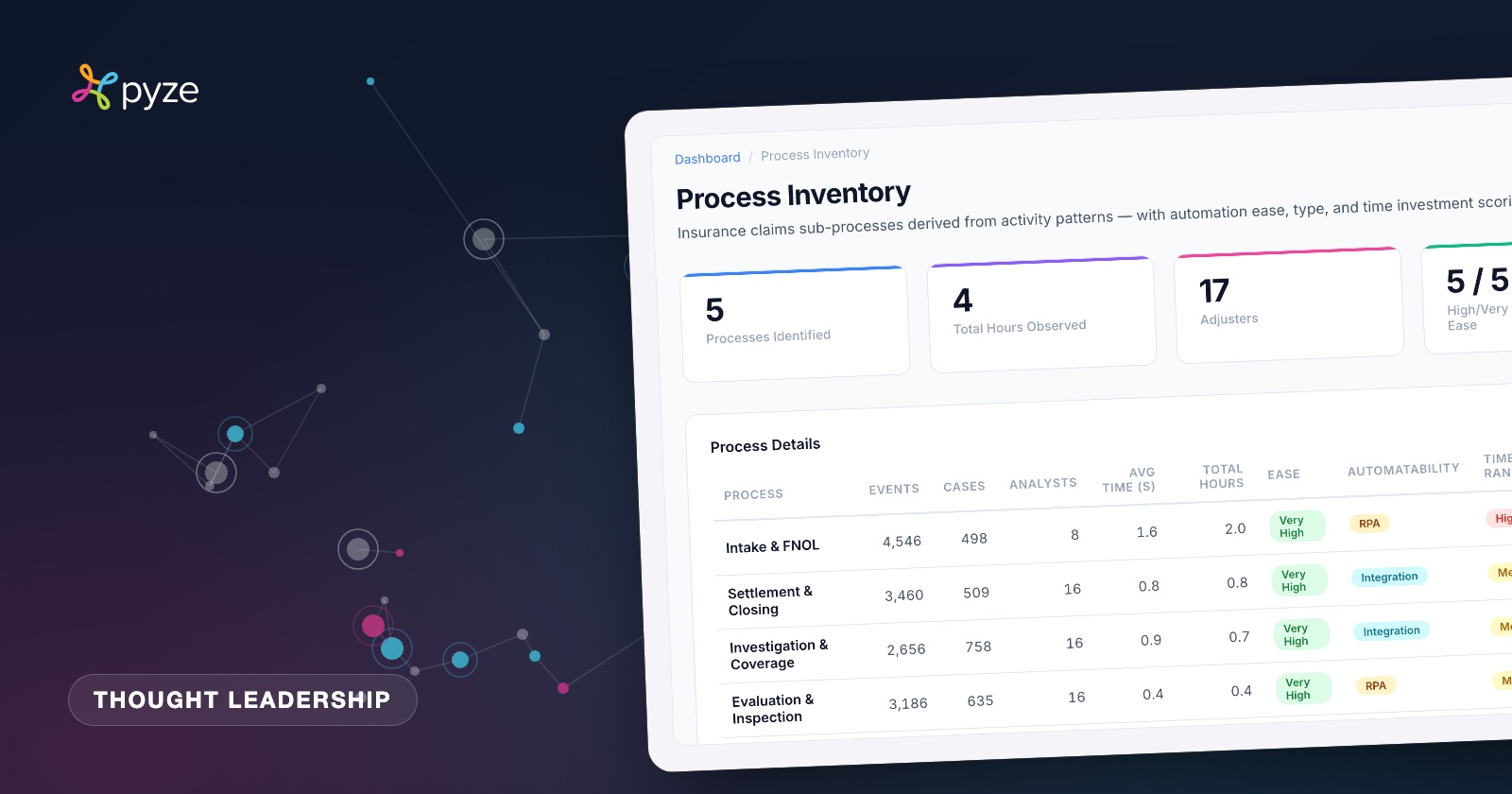
Measure the adjuster workday and the claim lifecycle
Pyze measures how claims and underwriting work is performed across the platform and surrounding applications, then measures what changed after AI agents are deployed.
Engagement archetypes from Pyze deployments in this sector rather than a single named account.
The claims platform records the claim. It does not record the searching, checking, follow-up and re-keying that determine how long the claim takes, which on the engagements we have run is a large share of the adjuster day.
Common Findings in Insurance
Four patterns that recur across engagements, each shown with the measurement and the resulting change.
Cycle time is measured end to end, but the portion that is hands-on effort is not known.
SimplifyWall-clock and hands-on time are separated, so waiting time is distinguished from working time.
Effort is attributed to the step that consumed it, which is the basis for pricing an automation candidate.
First notice of loss is templated, yet adjusters complete it differently.
StandardizeSteps performed consistently that appear in no procedure, and procedure steps that are routinely skipped without consequence.
The procedure is updated to reflect what experienced staff do, and the remaining deviation becomes a coaching list.
Coverage checks are repeated across systems that should hold the same data.
AutomateThe same value is verified two or three times in different applications within a single claim, which is rework the claim record does not show.
Verification is consolidated at the point the value first enters the file, which removes the repeat.
An agent was deployed into triage and average handling time increased.
AgentifyThe agent absorbed the claims that settle at first pass and left the ones that do not, so average handling time rises in the first month of a working deployment.
Absorbed, assisted and retained work are measured separately, so the deployment is assessed on released capacity instead of an average that no longer reflects the work.
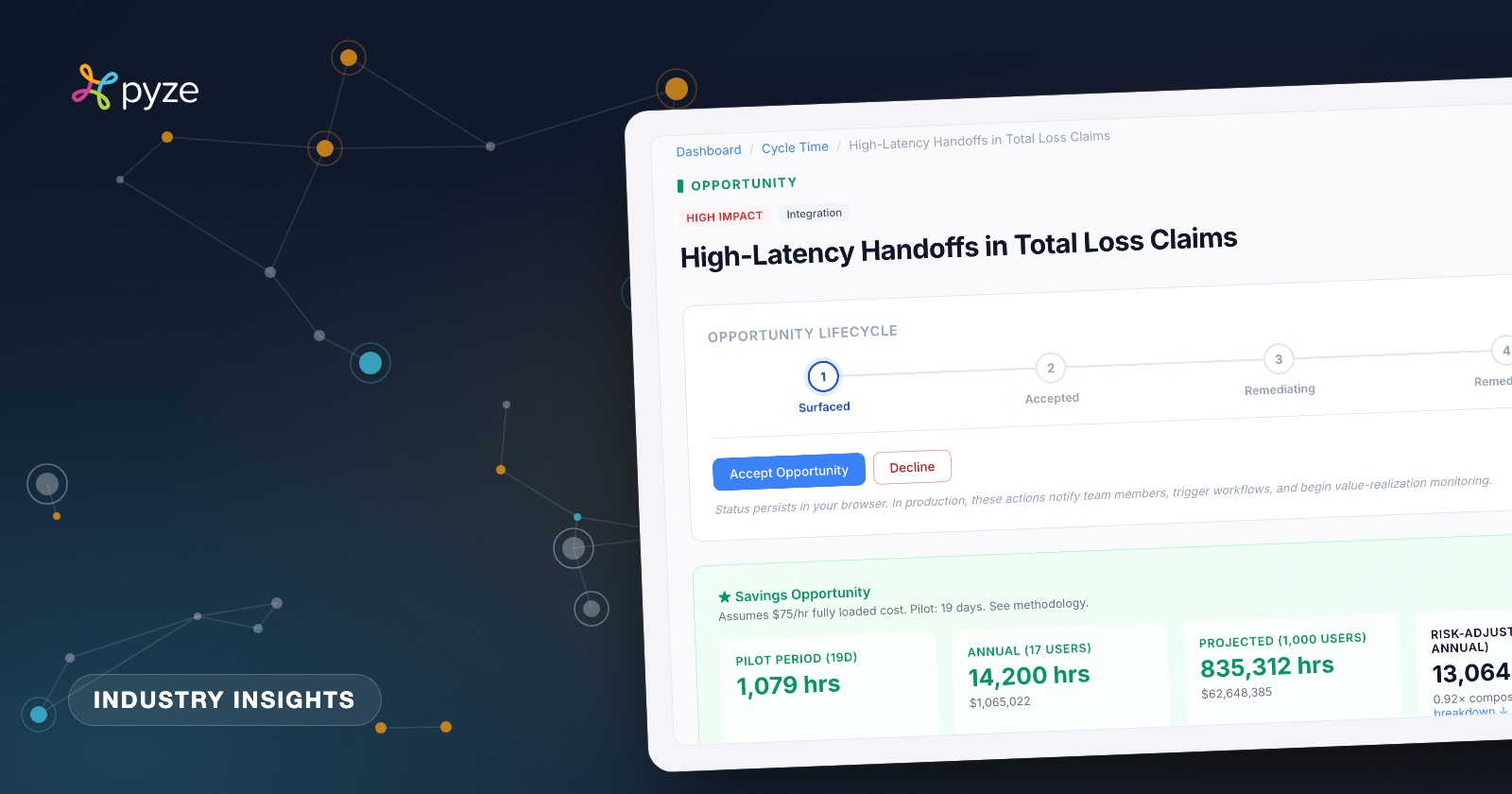
Opportunity Register
A sample register, sorted by the lever that resolves each opportunity. In an engagement, each line carries measured hours, a named owner and the evidence it was derived from.
Systems typically instrumented
Capture covers browser-delivered and thick-client applications, including virtualized estates, with no change to how anyone works.
Roles Involved
Instrumentation is configured per application rather than per person, so the population in scope is set during scoping and is not a deployment constraint.
How an Engagement Runs
Baseline, blueprint, transform, prove
The same four stages apply in every sector. The fourth stage repeats the baseline measurement, which makes the engagement an ongoing operating capability rather than a one-time report.
Baseline
What the work costs today, measured across every person and application.
Blueprint
Procedures, application rules and execution evidence, read as one target state.
Transform
Where each of the five levers applies, priced and owned.
Prove
The after state measured against the baseline, using the same method.
Frequently Asked Questions
Can Pyze see inside the claims platform itself?
How does this differ from the task mining we evaluated?
Functions
Related
Start with a measured baseline
Six weeks from instrumentation to a priced opportunity register, and the baseline stays in place so later quarters are measured rather than re-estimated.