
Measure How Submissions and Policy Changes Are Processed and Identify Where to Reduce Turnaround Time
Pyze measures how underwriters, underwriting assistants and policy service staff work each submission, quote, endorsement and renewal, and identifies where handling time is spent outside the policy administration system.
Engagement archetypes from Pyze deployments across underwriting and policy servicing operations rather than a single named account.
The policy administration system records the quote, the bound policy and the transactions that follow. The preparation before each of those is done elsewhere: submissions are read in email and broker portals, data is enriched from third-party sources, rating inputs are keyed in and referral notes are written in spreadsheets. That preparation determines quote turnaround and the capacity of the underwriting team, and it is not visible in the system of record.
Common Findings in Underwriting and Policy Servicing
Four patterns that recur across engagements, each shown with the measurement and the resulting change.
Submissions arrive in many formats and a large share of underwriting assistant time goes to intake before any risk assessment begins.
AgentifyAssistants read submission emails and attachments, transcribe exposure and location data into the policy system and rating tools, and request missing information from brokers. The same data elements are re-entered across two or three applications.
Submission data is extracted and validated against appetite and completeness rules, so underwriters receive a structured file and assistants handle the exceptions.
Quote turnaround varies widely between underwriters and between lines of business.
StandardizeTime to quote depends on the number of external data sources consulted and the number of referral steps, which differ by underwriter for comparable risks. Waiting for information accounts for much of the elapsed time.
The data sources and referral thresholds used by the fastest underwriters on comparable risks are documented as the standard working path.
Endorsements and mid-term changes consume service staff time and queues build at renewal periods.
AutomateMany change requests are routine and follow the same validation steps, but each is processed through manual checks across the policy system, billing and document tools. Complex changes are not separated from routine ones at intake.
Routine endorsements are processed from the request through the deterministic steps, and only changes that require judgment reach a service specialist.
Renewal preparation requires manual review of every policy, including those with no material change.
SimplifyUnderwriters open each renewal and compare prior terms, loss experience and exposure changes across several screens. A large portion of the review time is spent on renewals that are renewed on unchanged terms.
Renewals are triaged on measured criteria, and full review is reserved for the policies where the data shows a material change.
Opportunity Register
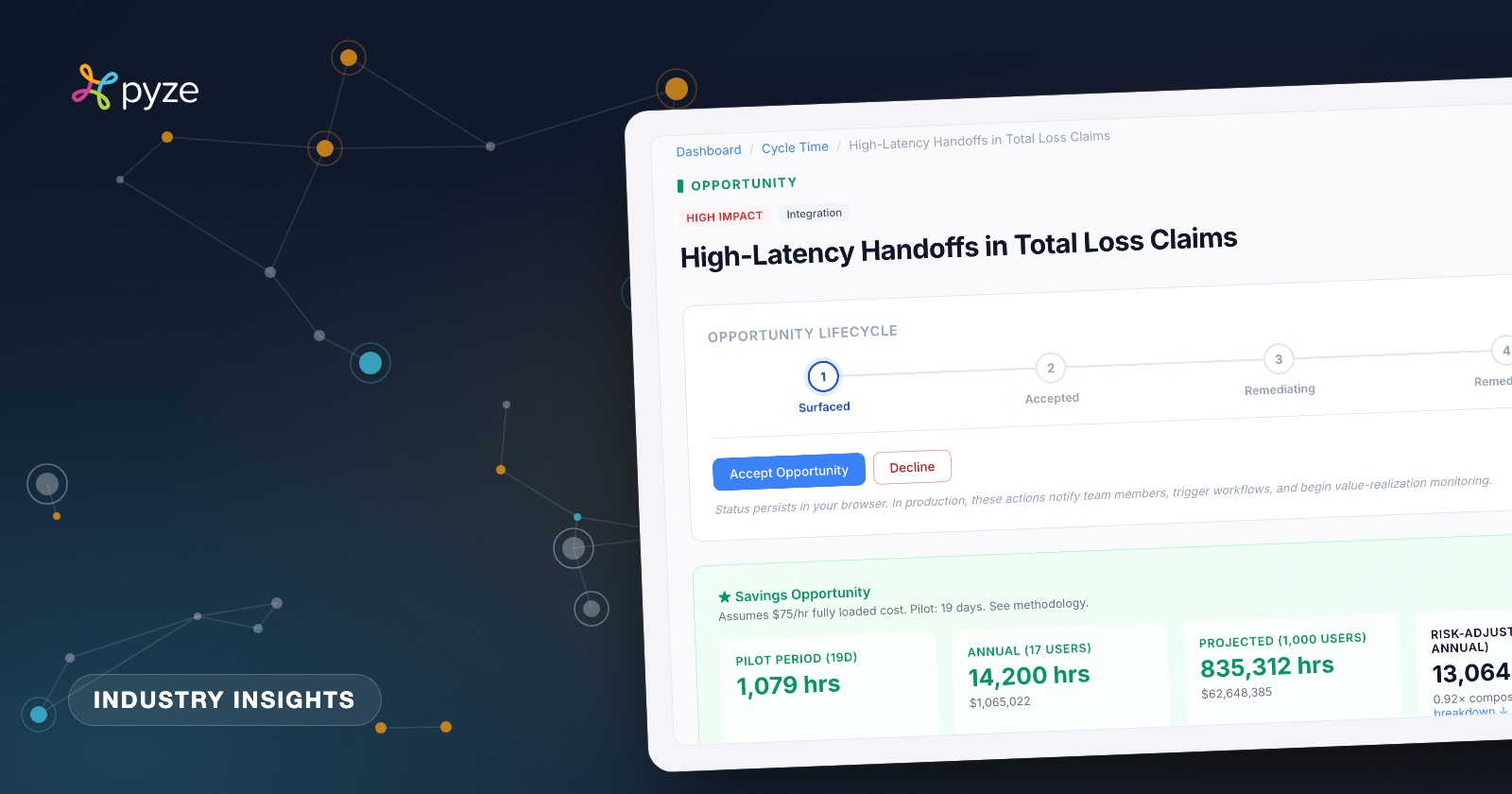
A sample register, sorted by the lever that resolves each opportunity. In an engagement, each line carries measured hours, a named owner and the evidence it was derived from.
Systems typically instrumented
Capture covers browser-delivered and thick-client applications, including virtualized estates, with no change to how anyone works.
Roles Involved
Instrumentation is configured per application rather than per person, so the population in scope is set during scoping and is not a deployment constraint.
How an Engagement Runs
Baseline, blueprint, transform, prove
The same four stages apply in every sector. The fourth stage repeats the baseline measurement, which makes the engagement an ongoing operating capability rather than a one-time report.
Baseline
What the work costs today, measured across every person and application.
Blueprint
Procedures, application rules and execution evidence, read as one target state.
Transform
Where each of the five levers applies, priced and owned.
Prove
The after state measured against the baseline, using the same method.
Frequently Asked Questions
How is this different from the reporting in our policy administration system?
Can this be used to evaluate underwriting authority and referral rules?
What is captured about the underwriter?
Associated Titles
Roles
Other functions
Related
Start with a measured baseline
Six weeks from instrumentation to a priced opportunity register, and the baseline stays in place so later quarters are measured rather than re-estimated.