
Business cases for automation tend to fail in one of two ways. Either they are too vague to evaluate, or they are so precise that the numbers are not credible. A better approach is a small model with every assumption visible, so reviewers can challenge the figures they disagree with.
This is the model we use for discussion, expressed per 1,000 full-time equivalents in scope.
The Model
| Assumption | Value |
|---|---|
| FTEs in scope | 1,000 |
| Productive hours per FTE per year | 1,800 |
| Share reclaimable through automation and augmentation | 10% to 18% |
| Fully loaded cost per hour | $45 |
The arithmetic has three steps. 1,000 FTEs at 1,800 hours is 1,800,000 productive hours a year. Ten to 18 percent of that is 180,000 to 324,000 hours. At $45 an hour, that is roughly $8.1M to $14.6M a year, which we round to $8M to $15M per 1,000 FTEs.
This is an illustrative figure for discussion. It is not a commitment or a forecast for any specific operation. The model is useful because the reader can change the assumptions and see the result change.
Why the Range Is Conservative
The 10 to 18 percent range is modest. It covers work that can be automated or augmented. It excludes benefits that are real but harder to price: accuracy gains, faster service-level performance, fewer escalations, and any revenue lift from faster response. If those matter to a given case, they are additional to the figure above.
Reclaimable does not mean removed. Reclaimed hours might be redeployed to higher-value work, absorbed into growth, or taken out as cost. That decision belongs to the business, and the model does not make it.
Sources of the Assumptions
Three of the four inputs are known or can be estimated: headcount in scope, productive hours and loaded cost. The reclaimable share cannot be estimated from a desk, and it is the figure a baseline is designed to replace.
Before a baseline exists, 10 to 18 percent is a reasonable planning range. After the team has captured how the work is performed, the share becomes a measured figure per process, built from the opportunities that have been evidenced. Each opportunity carries its own hours, its own type of change, and the supporting data. The total is a sum of lines that can be inspected.
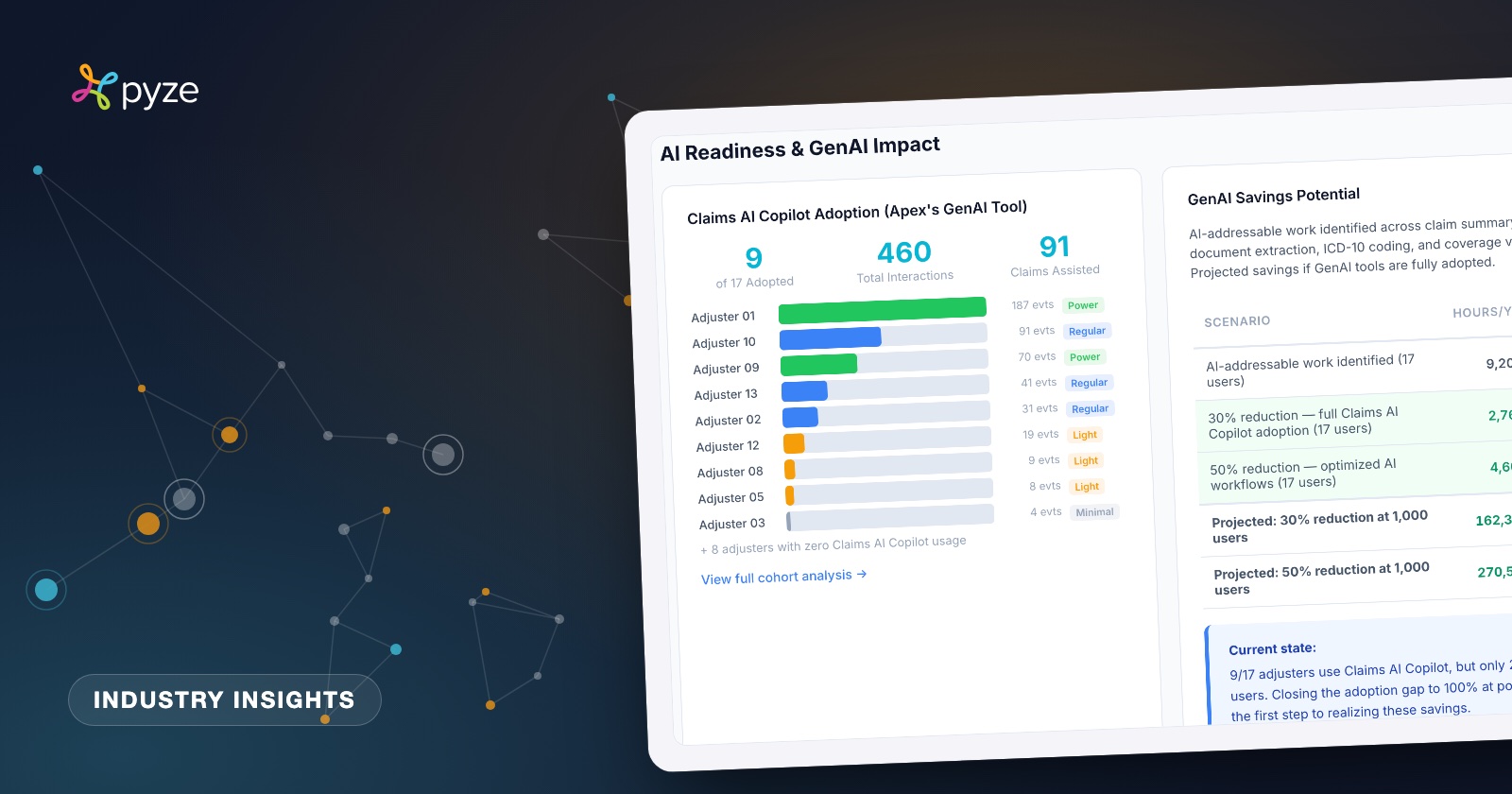
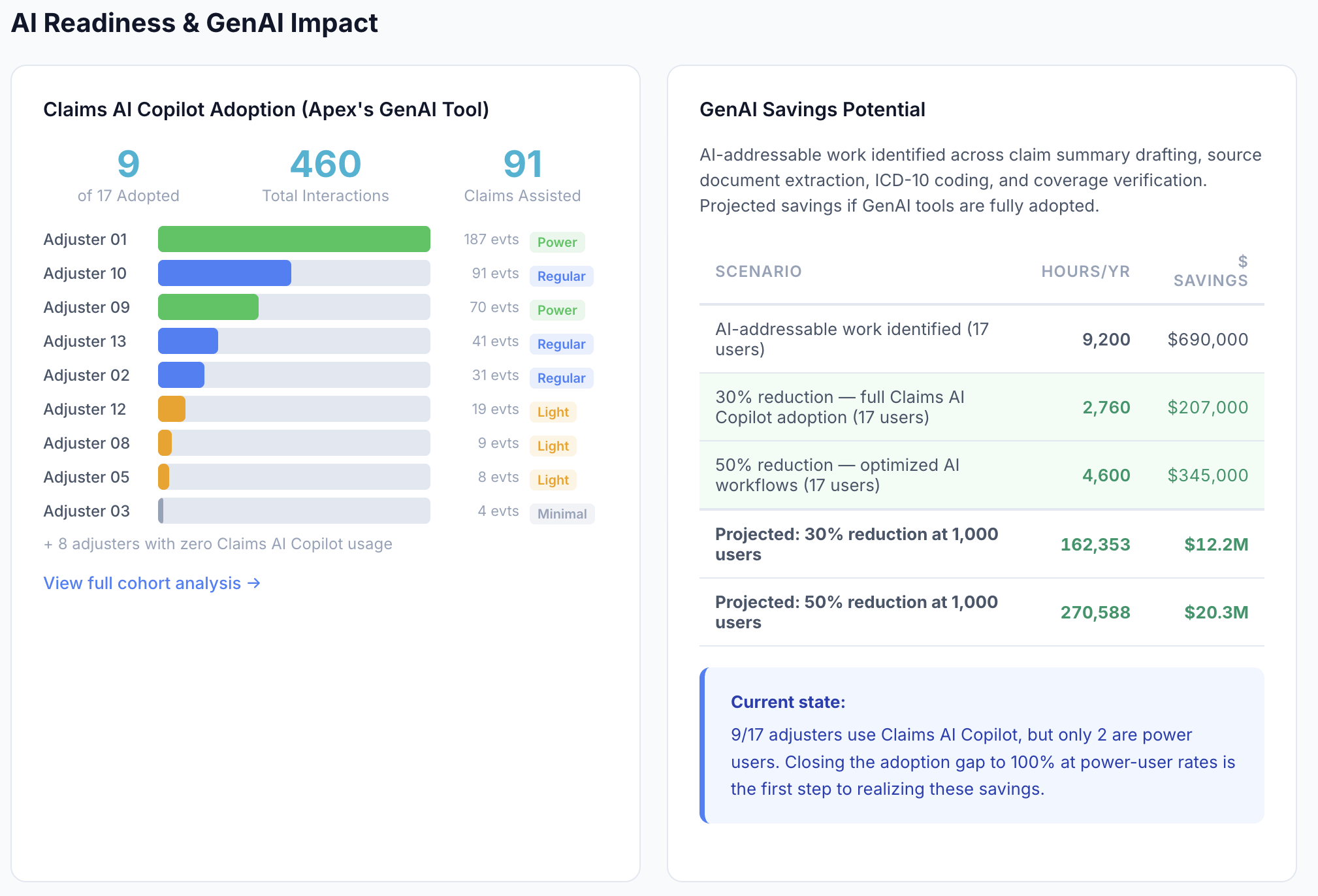
The screen below, from the Pyze demo environment, shows adoption of an AI tool by user, with a savings table that scales a small pilot population up to a larger one under stated scenarios. The scenarios are labeled as projections, and the current state is shown next to them.
Repeated Measurement Increases the Estimate
The first pass is not the last. Each cycle of measuring, changing and re-measuring surfaces additional reclaimable work, because work that was hidden behind the largest problem becomes visible once that problem is fixed. The baseline becomes more precise each quarter.
For this reason the model is a starting point. It should be presented to the team, the assumptions adjusted during the discussion, and the team should agree which assumptions to replace with measured values first.
How to Use the Estimate
Use the estimate to decide whether a baseline is worth running. If the conservative end of the range is already material for your headcount, the next step is to capture how the work is performed and replace the percentage with evidence. If it is not material, you have avoided an unnecessary program.
For reference, a tier-1 Canadian retail bank identified $3M+ in operational cost and 50K+ hours across 1,100 retail centers, and a European bank identified 250K+ hours and EUR 5M+ across financial crime operations.
Where to Go Next
- See how AI Discovery and Effectiveness converts a planning range into measured opportunities.
- Read Why Average Handle Time Can Rise After a Successful Agent Deployment before judging a deployment on one metric.
- Talk to us about running the model against your own headcount.