
Teams running an enterprise AI factory usually report that model quality is not what slows them down. The models are good enough and the pilots work. The delays come before and after the pilot: deciding which work to hand to an agent, and then showing that the handoff paid off.
Both steps require the same input, which is trustworthy data about how work runs today.
Data Readiness Is the Constraint
Accenture’s research, AI-Ready Data for the Agentic Era, quantifies the problem. Only 7% of organizations have the data readiness required to scale advanced AI. More than 80% delay, limit or alter AI initiatives because of data-related risk. And 72% describe themselves as in production with AI while still lacking trusted, governed data.
Taken together, these figures show that most organizations have something running, but few can say with confidence that it is aimed at the right work or that it is delivering the expected results. A model can only be targeted as well as the data that identifies where to apply it.
What Data Is Missing
Most companies have reporting data. It describes outcomes: a case opened, a status changed, a field written to the system of record. That data is useful but incomplete.
An agent needs a different view. It needs to know what the work is, in what order people perform it, where the effort goes, and which steps are repeated and which are exceptions. Much of this happens between systems: the lookup in a second application, the spreadsheet on the side, the message to a colleague. None of it is recorded in the system of record. We describe this gap in What System Logs Miss About How Work Gets Done.
When a team selects automation candidates from workshops and process diagrams, it is working from a description of the work instead of a measurement of it. The pilot may still succeed, but the missing evidence becomes a problem when the team tries to scale.
Three Conditions for Returns on AI
For an AI factory to deliver returns, three conditions need to hold.
See the work. Identify what operations teams do at the task and activity level, in addition to the transaction level. This requires capturing how work moves across applications, with timing and sequence, so a real process can be distinguished from the one on the slide.
Find the leverage. Identify, evidence and rank where agents and automation create measurable value. Not every task should be automated and not every process needs a copilot. A ranked list with the evidence behind each line gives the team a prioritized backlog to work from.
Prove the return. Measure what each agent changes in speed, accuracy and cost, and compare it against a baseline taken before anything changed. If the baseline was never captured, any claimed improvement cannot be verified.
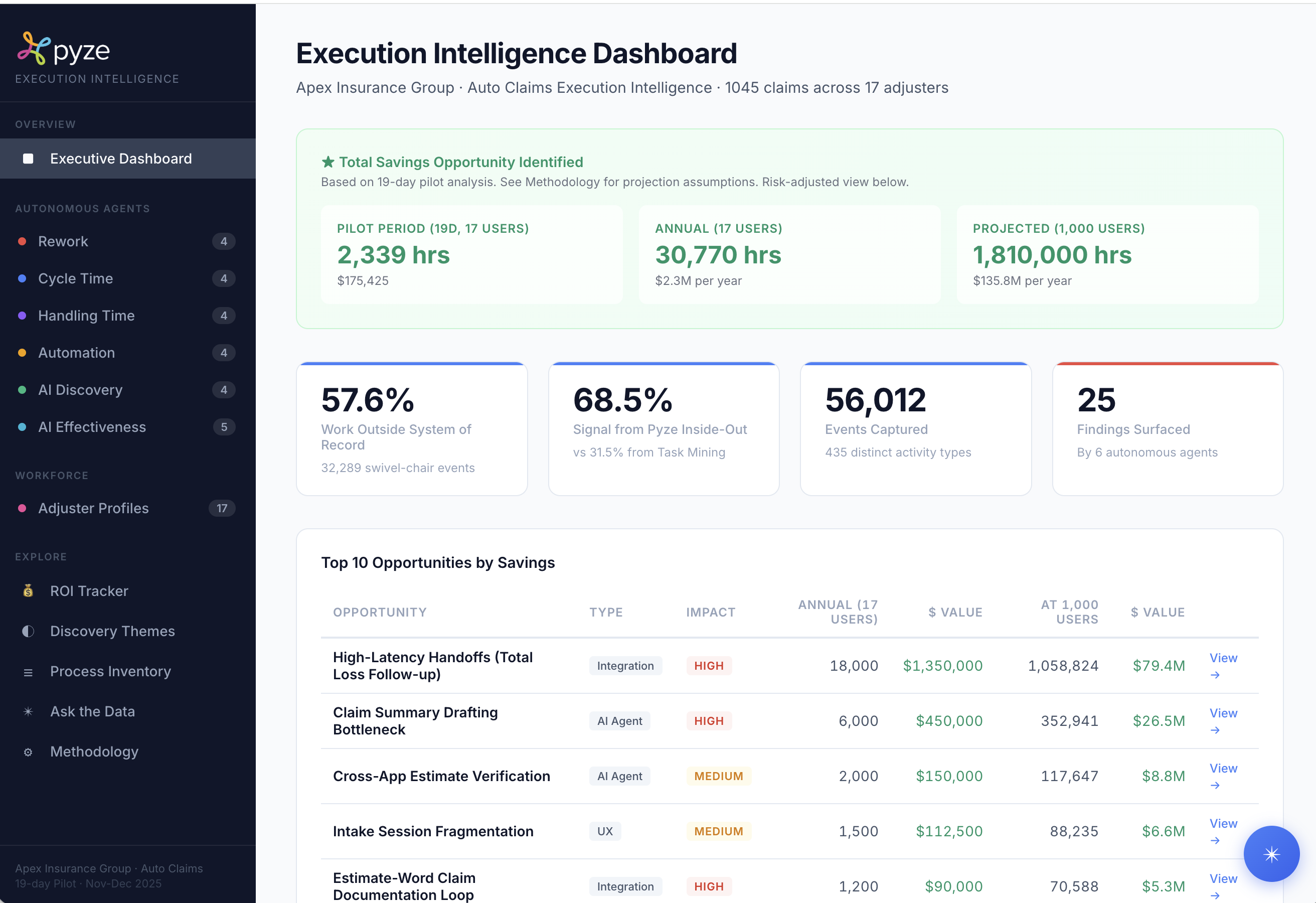
The screen above is from the Pyze demo environment. It shows a single view in which every opportunity carries a size, a type and a link to the supporting evidence.
Start With High Volume and High Scrutiny
The recommended starting point is one process that is high in volume and heavily regulated. High volume provides enough observations to trust the patterns. Heavy regulation means the work is already expected to follow a documented standard, so actual practice can be compared against procedure.
This also builds the evidence layer the rest of the program depends on. The same capture that sizes the first opportunity later measures the first deployment, and the baseline improves with each cycle. Pyze does not run your agents. It identifies where they belong and measures whether they paid back.
Pyze collects interaction metadata only: which application, which screen, and the sequence and timing of actions, limited to a whitelist of business applications. It never captures keystrokes, field values, free text or screen contents, and the unit of analysis is the process, not the person.
Where to Go Next
- See how the platform ties the pieces together in the Execution Intelligence overview.
- Read how AI Discovery and Effectiveness picks the right work and measures the result.
- Review the methodology behind the baseline.