
Pega Estate Rationalization
Pyze recovers the requirements for a Pega modernization from the application rules and from how people work, so each journey can be reimagined, consolidated or retired.
Modernization Challenges
The knowledge a transformation requires is spread across rules that are difficult to review at scale and user behavior that has not been measured.
Business Rules Hold the Existing Requirements
Years of investment sit in rules and flows. A rewrite that does not use them must reconstruct the requirements from memory.
User Behavior Shows How Work Is Performed
What people do differs from what the application is configured to do. A rebuild that copies the configuration also copies the workarounds.
Interview-Based Discovery Does Not Scale
Discovery by interview takes weeks per journey. Hundreds of flows make that a multi-year plan before the first build.
Using recovered rules and observed behavior, each journey can be reimagined, consolidated or retired in waves, with each requirement traced to evidence.
How the Engine Works
The engine combines application configuration with observed user behavior.
Input
Pega application
Rules, flows, case types, screens and data model, extracted directly from the platform.
Input
User behavior
What people do across desktop and browser: steps, sequence, time and workarounds.
Pyze engine
Business intent recovered from the application.
Configured versus observed: gaps, workarounds, unused paths.
Requirements, build artifacts and a measured baseline.
Rationalization map
Reimagine, consolidate or retire, by journey.
BRD, PRD and TRD
Per journey, ready to review.
Constellation build artifacts
Generated from your own components and patterns.
Measured baseline
Adoption and productivity, before and after.
Runs inside your environment with approved models. No public endpoint. Nothing leaves your network.
Configured vs. Observed Behavior
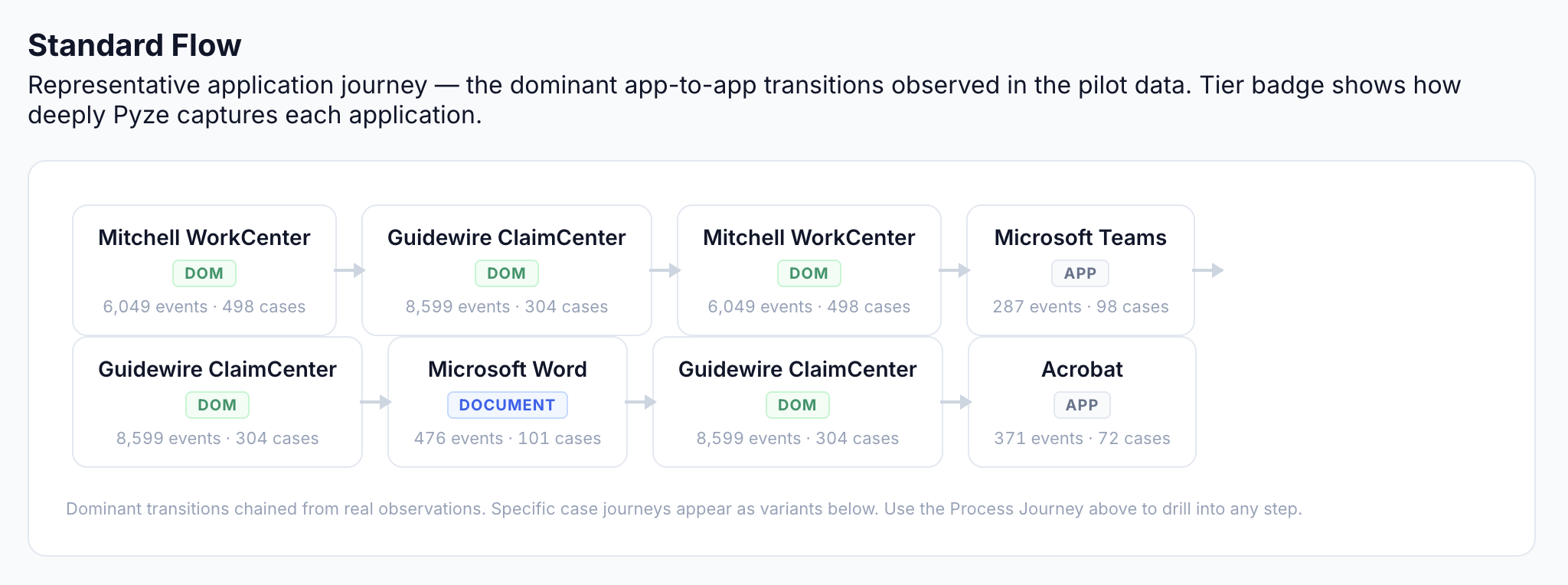
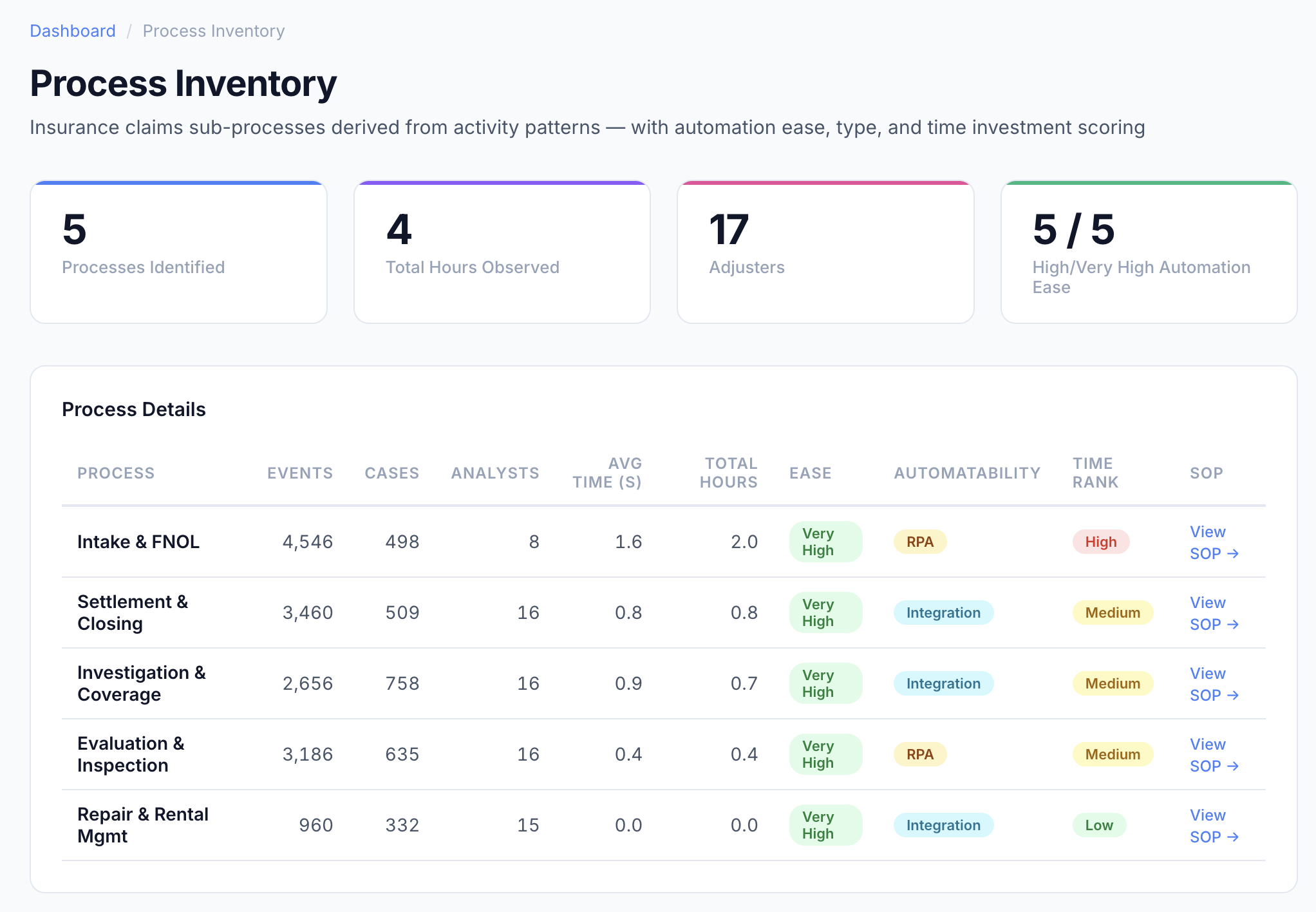
The differences between configuration and observed behavior define the requirement set. Captures from the Pyze demo environment.
Deployments in Complex Environments
Execution Intelligence observes how work is done and identifies friction to remove, simplify or automate. Modernization Intelligence recovers rules, flows and screens and generates traceable build artifacts.
Card issuer
Acquisitions
Acquisitions transformation with 66% less effort.
Canadian bank
Retail banking
And $3M+ identified across 11,000 employees in 1,100 retail centers.
Canadian bank
Fraud automation
Of 2M+ monthly fraud cases, with 15% less time per case.
European bank
KYC at scale
And 5M+ euros identified across KYC, transaction monitoring and payments.
Results by Flow
Two anonymized results. Results for your estate are measured the same way.
Large US health insurer
Rules recovered and rebuilt
Whole application ingested. Business requirements, product requirements and technical design generated for a case type, about 2 days from a configured environment to every deliverable.
Tier 1 card issuer
Journey to production code
Per-flow results from a moderate-complexity journey.
Phased Approach
Start with the first journeys, then rationalize the remaining journeys in waves.
What Pyze does
- Reads your application and observes user behavior inside your environment
- Reverse engineers the rules and reconciles them with what people do
- Generates requirements and build artifacts for the first wave
What you receive
- A mapped rule and flow inventory with business intent
- BRD, PRD and TRD for the first journeys
- A gap report: configured versus observed
- A measured acceleration figure on your own estate
Projected acceleration
Faster to production than a manual rebuild. Observed at about 3x per flow on a comparable estate. Confirmed on your estate during the first wave.
Scope the First Wave
A working session to pick the first journeys and agree what gets measured.