
Most standard operating procedures are written once, signed off and filed. The work then continues to change and the document does not. A year later the SOP describes how the process was meant to run in the quarter it was written, and the people who do the work know it.
This gap is manageable when the only users of the procedure are people who can fill in the blanks from experience. It becomes a problem when an agent is asked to follow the procedure, or an auditor is asked to rely on it.
Why Prose SOPs Cannot Be Tested
A team lead asked whether the SOP is being followed will usually give an answer based on a handful of cases. An auditor will work from a sample. Neither measures how the work is performed across every case, every desk and every week.
A SOP written as prose cannot be scored. It cannot show that step four is skipped in a third of cases, that a step added by one team is now done by everyone, or that two steps are routinely swapped. The document and the work have diverged, and no system records by how much. A standard that cannot be scored cannot be enforced.
From Document to Standard
The approach is to treat the SOP as a specification: precise enough that work can be checked against it. In practice this is a five-part loop.
- Discover what the work actually is, including variants. This means the paths people really take, not the standard path from the last workshop.
- Specify the SOP as a machine-readable standard, with steps, order and the conditions that matter.
- Conform. Score every execution against that standard, step by step.
- Deploy agents where conformance shows they can act. A process that people cannot follow consistently is not ready to hand to an agent.
- Measure agent and human work against the same standard.
The last step is often skipped. If agents are held to one standard and people to another, it is not possible to say which is performing better or where the procedure itself is wrong.

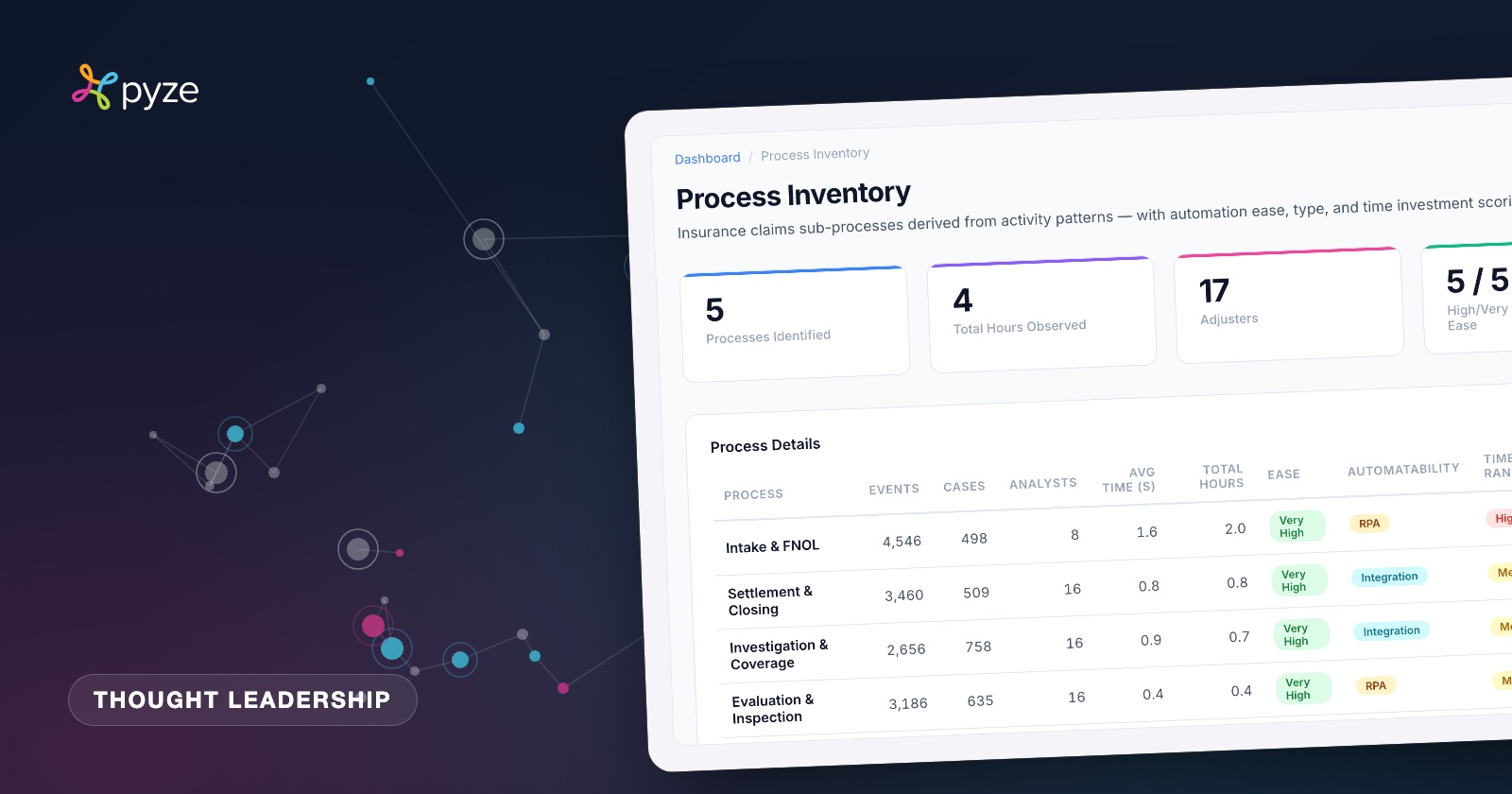
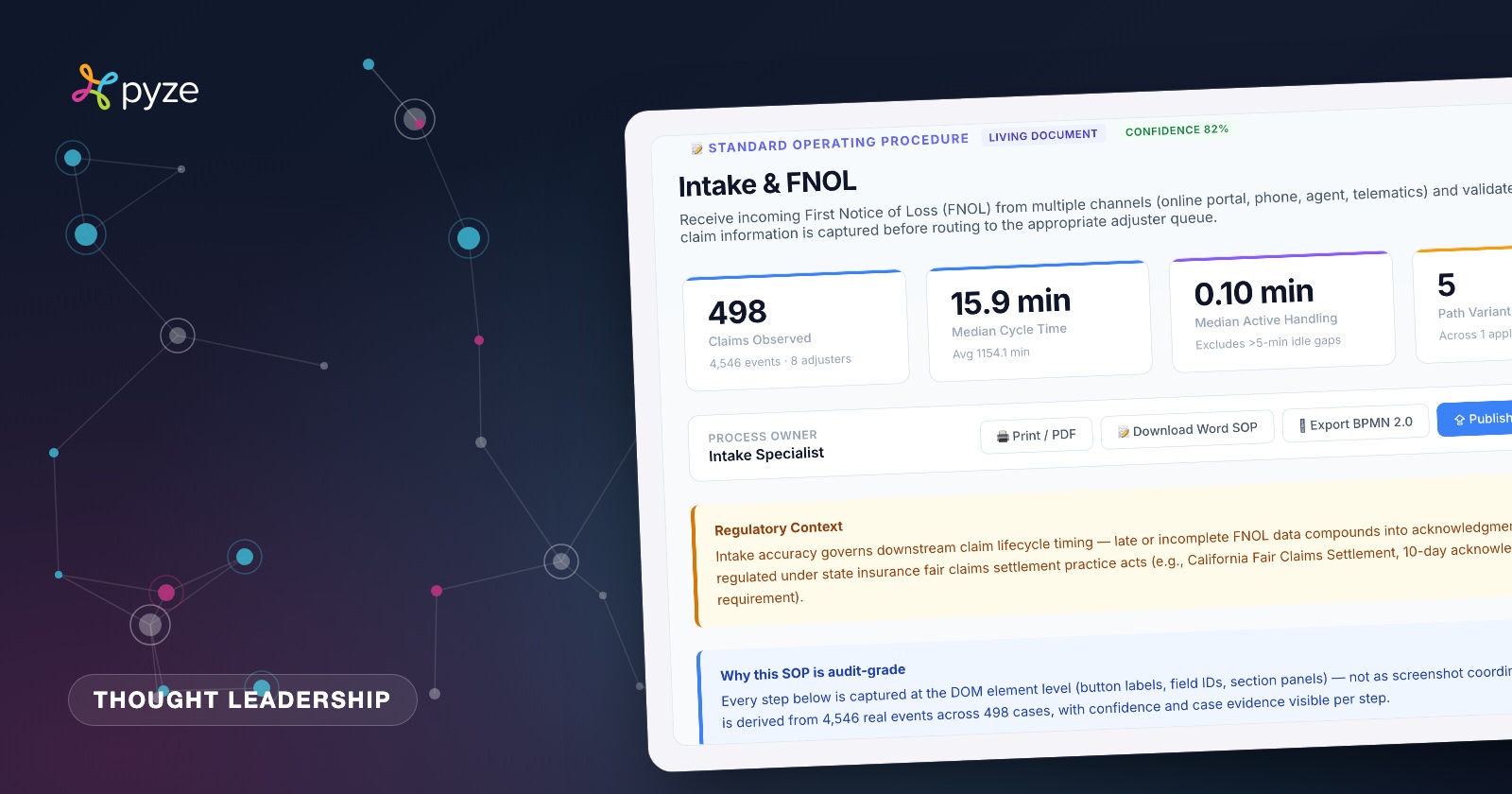
The screen above is from the Pyze demo environment. Each step in the procedure is derived from observed work instead of written from memory, carries a confidence score, and links back to the cases it came from. The procedure remains current because the underlying evidence keeps updating.
When Capable People Deviate
Once every execution is scored, a different kind of finding appears. Sometimes a person misses a step and coaching is the right response. More often, experienced people deviate in the same place and in the same way, week after week.
That pattern indicates a design defect in the SOP. The step may be unnecessary, in the wrong order, or harder to follow than to skip in the current system. Revising the procedure is more durable and less costly than retraining staff to follow a procedure that does not match how the work is done.
The same logic applies once agents are in the queue. When a person accepts, overrides or ignores an agent’s output, that is a signal. An override means either the agent is wrong or the person is, and both are worth knowing. The purpose of recording it is to find where the standard or the agent needs to change, and not to rank individuals. User identifiers stay pseudonymous, and the unit of analysis remains the process.
Why Regulated Operations Adopt First
In a regulated environment the value is straightforward. The organization has an auditable standard, every execution is scored against it, and the same test applies to an agent and to a person. Evidence is attached to each step, and the regulatory context stays with the procedure instead of being kept in a separate binder.
This moves a pilot toward an operating model. A pilot shows that an agent can do the task. An operating model shows that the task is defined, monitored and improved, with a record of how it was performed that someone outside the team can inspect.
Where to Go Next
- See how SOP Intelligence generates and audits procedures from real execution.
- Read how the variance between a configured process and an observed one becomes a requirement: Using the Gap Between Configured and Observed Behavior as a Requirement Set.
- Review the full approach on the methodology page, or book a demo to see it on a process of your own.